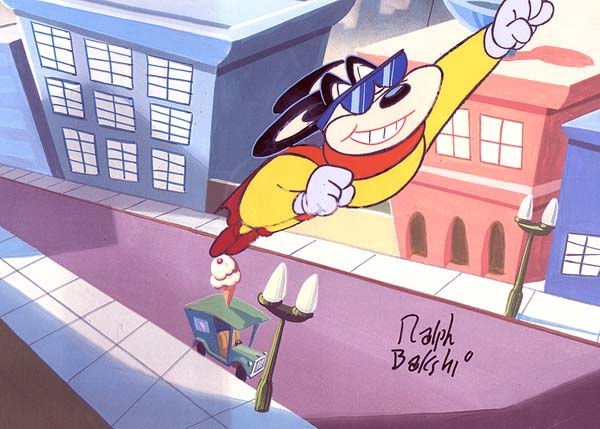
Mighty Mouse: The New Adventures
(1987) A bold reinvention of the classic superhero mouse. Bakshi assembled a new generation of animators and artists whose experimental approach helped inspire the modern animation renaissance of the 1990s.

Mighty Mouse: The New Adventures (1987)
Rebuilding Saturday Morning Animation
By the mid-1980s, American television animation had become highly formulaic. Tight schedules, limited budgets, and merchandising demands often left little room for experimentation. While animation remained popular, much of the creative energy that had fueled earlier decades had faded.
Ralph Bakshi saw an opportunity.
When he was invited to revive the classic character Mighty Mouse, he approached the project not as a nostalgic reboot but as a chance to reinvent television animation itself. Rather than rely on established studio formulas, he assembled an unconventional team of young artists, writers, and animators who were encouraged to challenge expectations and take creative risks.
The resulting series, Mighty Mouse: The New Adventures, was unlike anything else on television. Episodes moved with an energy and spontaneity rarely seen in Saturday morning cartoons. Visual styles shifted from scene to scene. Humor ranged from absurd and satirical to surprisingly sophisticated. The animation itself felt alive, driven by artists rather than committees.
Many of the creators who worked on the series would later become major figures in animation, helping launch what is now recognized as the animation renaissance of the 1990s. The show's influence can be felt in many creator-driven productions that followed.
Although its original run was brief, the series demonstrated that television animation could once again be artist-led, inventive, and unpredictable.
Why It Matters
-Helped spark the modern animation renaissance.
-Introduced a generation of influential animators.
-Challenged television animation conventions.
-Demonstrated that creator-driven cartoons could succeed.